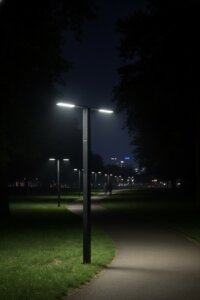
Most of the time, we think about outdoor lighting as a given.
The lights turn on at night. Streets feel safer. Parks stay usable. Life continues.
Until one day, the grid goes down.
Power outages are often treated as rare or extreme events.
In reality, they’re becoming more common – caused by storms, heat waves, aging infrastructure, or unexpected failures. When that happens, outdoor lighting is usually one of the first things we lose.
And when the lights go out, public spaces change immediately.
Lighting Is Often Treated as Non-Critical. In Practice, It Isn’t.
In many infrastructure conversations, lighting is still framed as a secondary system.
Important, yes – but not essential.
That assumption breaks down the moment there’s no power.
Dark streets, parks, trails, and public areas affect more than visibility.
They affect safety, accessibility, and how people move through their communities.
They change how secure a place feels, especially at night or during emergencies.
When lighting fails, the impact is not abstract.
It’s immediate and human.
Efficiency Isn’t Enough: The Missing Role of Resilience
For years, the discussion around solar lighting has centered on sustainability and cost savings.
Those benefits matter. Reduced energy use and lower operating costs are real advantages.
But recent outages across the country highlight something else that deserves equal attention: resilience.
Resilience asks a different question.
Not “how efficient is the system when everything works?”
But “what keeps working when something doesn’t?”
What Happens When Lighting Depends Entirely on the Grid
Traditional outdoor lighting is designed around one assumption: constant access to grid power.
When that assumption fails:
-
Lights shut off completely
-
Public spaces become vulnerable
-
Cities lose visibility and control over areas that still need to function
Backup solutions like generators are rarely practical for distributed outdoor lighting. They’re noisy, fuel-dependent, and not designed for parks, pathways, or neighborhood streets.
In many cases, there is simply no backup at all.
What Makes Resilent Outdoor Lighting Truly Resilient
Resilient lighting systems are designed to operate autonomously.
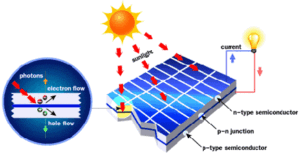
They generate and store their own power and don’t rely on a centralized grid to function.
Off-grid and hybrid solar lighting changes the equation:
-
Lights stay on during outages
-
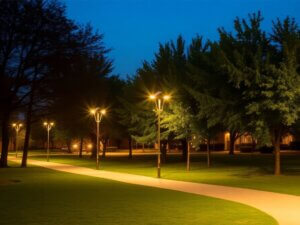
Critical outdoor areas remain illuminated
-
Communities retain a basic level of safety and usability
This isn’t about creating a dramatic “emergency mode.”
It’s about ensuring continuity when disruption becomes part of normal life.
Why Resilient Lighting Matters for Public Spaces
Outdoor lighting supports more than visibility.
It supports daily routines, public trust, and safe movement through shared spaces.
When lighting continues to operate during grid failures:
-
Parks and trails don’t become liabilities overnight
-
Perimeters remain visible
-
Communities feel less exposed during already stressful events
Resilience in lighting design is not a luxury feature.
It’s a planning decision.
From Alternative to Infrastructure
Solar lighting is often described as an “alternative” to conventional systems.
That framing misses the point.
When designed for autonomy and durability, solar lighting becomes part of core infrastructure – not a replacement, but a safeguard.
At Solarpath, this perspective shapes how we approach outdoor lighting.
Not as a trend or a sustainability add-on, but as a practical response to the reality that grid outages happen – and will continue to happen.
When the Grid Fails, What Stays On?
The real question isn’t whether solar lighting saves money or reduces emissions.
Those answers are already clear.
The question is simpler:
When the grid fails, what stays on?
Designing for resilience means deciding that some systems shouldn’t go dark just because everything else does.
And outdoor lighting is one of them.